PDF ebook · Volume 1
VOLUME 01 · Beginner friendly · From your first program to confident practice
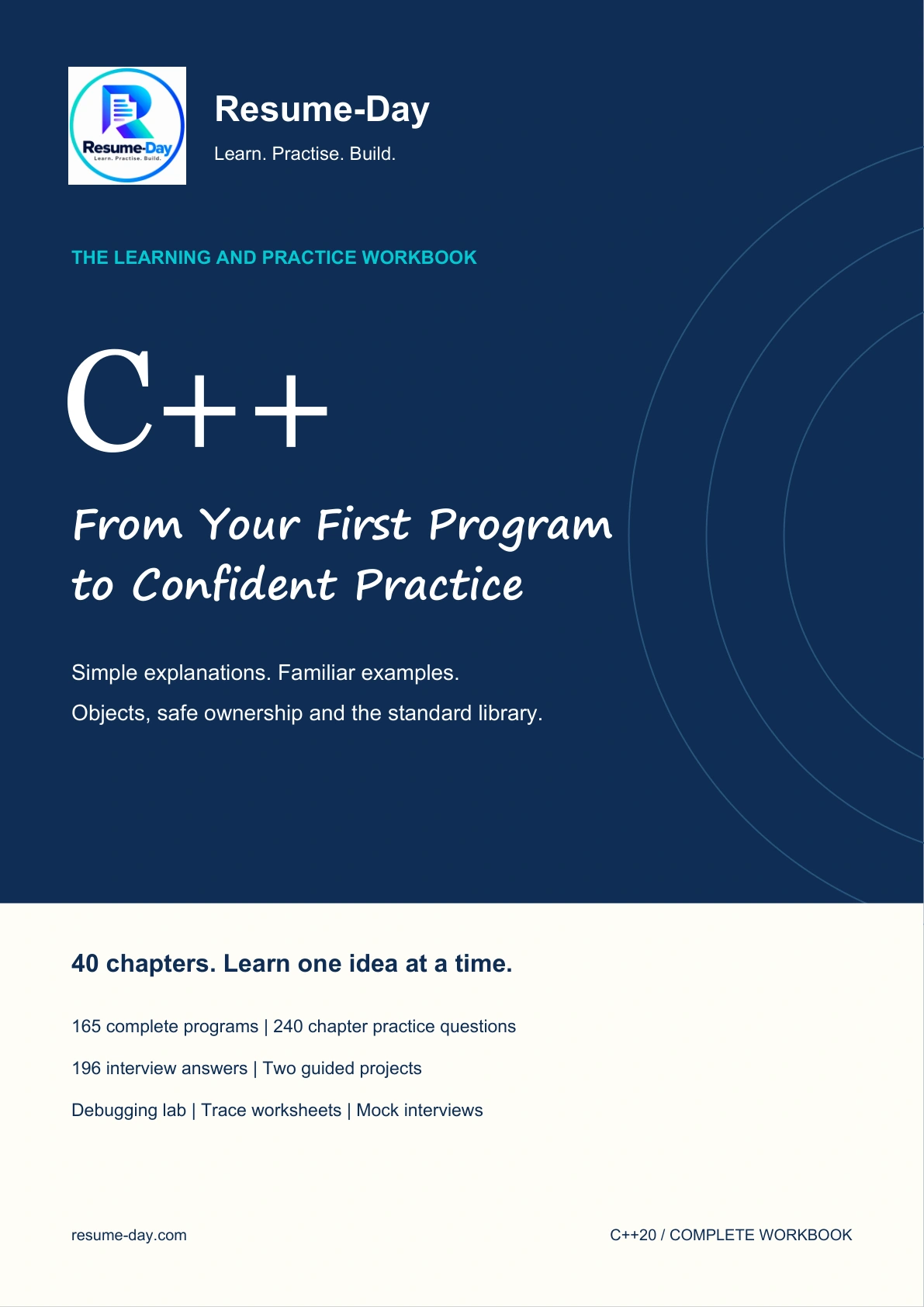
C++ Learning and Practice Workbook
Learn C++ in simple steps, from your first program to objects, safe ownership and the standard library. Practise with checked examples, explained answers and an extra workbook.
- 40 chapters with simple explanations and illustrated steps
- 165 complete C++20 programs with companion code and input/output files
- 240 chapter practice questions with answers and 20 extra independent tasks
- 196 chapter interview answers and three mock interviews with answer guides
- 12 debugging tasks and eight printable trace worksheets with answers
- Two guided projects, project extension plans and a revision schedule
Loading your price…
Log in to buy and keep your ebook in My Books. No resume subscription required.
For purchase help: info@resume-day.com
IS THIS BOOK FOR YOU?
Learn C++ one idea at a time
For BCA, MCA and B.Tech students, independent learners and students preparing for programming interviews.
BEFORE YOU START
What you need
No C or C++ experience is required. You will need a computer and a C++20 compiler for practice. The opening chapters explain setup and your first program.
This is a downloadable PDF, not a video course. A computer is recommended for running the examples.
LOOK INSIDE
What you’ll learn
- 01What is C++ and why learn it?
- 02Set up your tools and run a C++ file
- 03Your first C++ program: understand every part
- 04Print clear output and write useful comments
- 05Variables, constants and data types
- 06Read input and check it before using it
- 07Operators and conversions: calculate without surprises
- 08Conditions with if, else and else if
- 09Choose a matching option with switch
- 10Loops: repeat useful work and know when to stop
- 11Functions: give a small job a clear name
- 12References and passing values: copy or use the original?
- 13Function overloading and default arguments
- 14Scope, lifetime and recursion
- 15Arrays and std::array: keep related values together
- 16Strings: store, read and change text
- 17Pointers: work with an object's address
- 18Classes and objects: keep related data and actions together
- 19Access control and encapsulation: keep an object's rules in one place
- 20Constructors: give an object a clear starting state
- 21Destructors and cleanup: finish a job when an object leaves
- 22Useful class features: this, static members and friends
- 23Composition: build one class from useful parts
- 24Inheritance: describe a useful base-and-derived relationship
- 25Polymorphism and virtual functions: one interface, different behaviour
- 26Abstract classes: define a job that other classes must complete
- 27Operator overloading: give familiar symbols a clear meaning
- 28Copying and moving objects: create, replace or transfer a value
- 29Dynamic memory: create storage with a deliberate owner
- 30Smart pointers and ownership: let an object manage cleanup
- 31Templates: reuse an idea with suitable types
- 32Sequence containers: choose a useful home for a list of values
- 33Sets and maps: find values by a meaningful key
- 34Stacks, queues and priority queues: choose what comes out next
- 35Iterators, algorithms and lambdas: describe the operation clearly
- 36Exception handling: report a failure without losing cleanup
- 37Files and text conversion: save data and read it carefully
- 38Organize, debug and test: make a program you can trust
- 39Guided projects: build a complete console tool
- 40Revision and interviews: explain your choices, then prove them
BEFORE YOU BUY
A few helpful answers
How do I receive my ebook?
Log in, complete checkout, and wait for payment confirmation. Download the PDF from this page or My Books. You can return to your account to download it again.
Do I need programming experience?
No. Start with the computer guide and follow the chapters in order. Each new idea builds on earlier examples. Try the complete first ten chapters in the sample before buying.
What if payment is deducted but the download is missing?
Use “Already paid? Check payment” or refresh the payment in My Books. If it is still pending, contact info@resume-day.com with your order reference. Please do not pay again while confirmation is pending.
Can I check the teaching style first?
Yes. Open the free sample above to see the cover, contents, and opening lesson pages. The sample is only part of the book.
Please review our refund policy and terms before buying.