Complete C programming PDF ebook
C PROGRAMMING · After C basics · Learn, practise and prepare for interviews
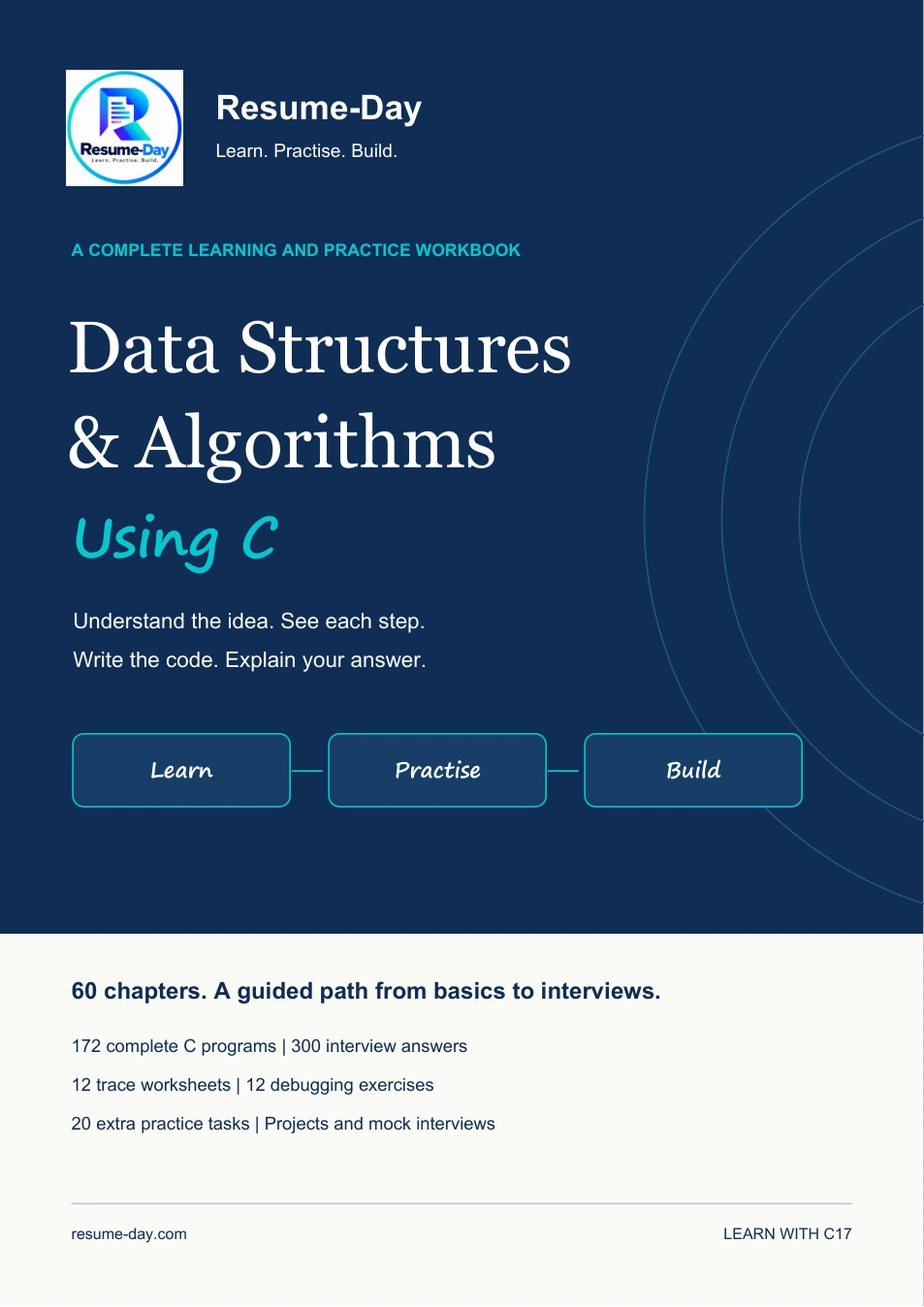
Data Structures & Algorithms Using C
Learn how to solve problems using C, one clear step at a time. Follow diagrams, complete programs and explained answers, then practise with the extra workbook.
- 60 chapters with simple explanations, diagrams and dry runs
- 172 complete C programs with companion source files and expected outputs
- 467 chapter practice questions with answers and 20 extra independent tasks
- 300 chapter interview answers and three mock interviews with answer guides
- Eight extra worked programs, 12 debugging tasks and 12 printable trace worksheets
- Two guided projects, extension plans, acceptance tests and revision sheets
Loading your price…
Log in to buy and keep your ebook in My Books. No resume subscription required.
For purchase help: info@resume-day.com
IS THIS BOOK FOR YOU?
Turn your C knowledge into problem-solving skills
For BCA, MCA and B.Tech students, independent learners and students preparing for coding interviews.
BEFORE YOU START
What you need
Know C variables, loops, functions, arrays and basic pointers. Chapter 2 revises C; this book is not a first introduction to programming.
This is a downloadable PDF, not a video course. A computer is recommended for running the examples.
LOOK INSIDE
What you’ll learn
- 01What are data structures and algorithms?
- 02C revision: the tools we need for DSA
- 03Understand the problem before writing code
- 04Write the steps, draw the flow and dry-run the result
- 05Time complexity: how does the amount of work grow?
- 06Memory use, best and worst cases, and choosing an approach
- 07Arrays: positions, capacity and everyday operations
- 08Minimum, maximum, second largest and simple counting
- 09Reverse, rotate and rearrange array values
- 10Prefix sums, suffix sums and range questions
- 11Two pointers: move two positions with a reason
- 12Sliding windows: reuse work across consecutive ranges
- 13Subarray problems and Kadane’s algorithm
- 14Matrices: work with rows and columns
- 15Strings in C: text, length and safe storage
- 16String problems: reverse, compare and count
- 17Pattern matching: from direct search to KMP
- 18Searching: linear search, binary search and boundaries
- 19Sorting basics and bubble sort
- 20Selection sort and insertion sort
- 21Recursion: smaller problems and returning answers
- 22Merge sort: split, sort and combine
- 23Quicksort: choose a pivot and partition
- 24Counting sort, radix sort and choosing a sort
- 25Linked lists: nodes, links and memory ownership
- 26Singly linked lists: insert, search, update and delete
- 27Linked-list problems: reverse, middle, cycles and merge
- 28Doubly and circular linked lists
- 29Stacks: the most recent item comes out first
- 30Stack problems: brackets, expressions and next greater entries
- 31Queues: serve the earliest waiting item
- 32Deques and useful queue problems
- 33Hashing: keys, collisions and fast lookup
- 34Binary trees and traversal orders
- 35Binary search trees: ordered lookup and deletion
- 36Tree problems: height, balance, paths and ancestors
- 37AVL trees: keep an ordered tree balanced
- 38Heaps and heapsort
- 39Priority queues: keep the best items and merge sorted work
- 40Tries: find words and shared beginnings
- 41Backtracking: try a choice, return and try another
- 42Backtracking problems: queens, maze paths and Sudoku
- 43Graphs: store places and connections
- 44BFS and DFS: explore a graph safely
- 45Graph cycles and two-group colouring
- 46Topological order: plan work with prerequisites
- 47Shortest paths: Dijkstra and Bellman-Ford
- 48Minimum spanning trees and disjoint sets
- 49Greedy choices: when a good next step is safe
- 50Greedy problems: enough rooms and cheaper merges
- 51Dynamic programming: save answers instead of repeating work
- 52DP on steps and grids: define where an answer ends
- 53Knapsack, subset sums and coin choices
- 54String DP: common subsequences and edit distance
- 55Bits and number tools for problem solving
- 56Changing range totals: Fenwick and segment trees
- 57Graph extensions: all pairs, strong groups and critical links
- 58More DP patterns: increasing subsequences and interval splits
- 59Guided projects: build, test and explain your choices
- 60Final revision: explain, solve, test and keep practising
BEFORE YOU BUY
A few helpful answers
How do I receive my ebook?
Log in, complete checkout, and wait for payment confirmation. Download the PDF from this page or My Books. You can return to your account to download it again.
Do I need programming experience?
No. Start with the computer guide and follow the chapters in order. Each new idea builds on earlier examples. Try the complete first ten chapters in the sample before buying.
What if payment is deducted but the download is missing?
Use “Already paid? Check payment” or refresh the payment in My Books. If it is still pending, contact info@resume-day.com with your order reference. Please do not pay again while confirmation is pending.
Can I check the teaching style first?
Yes. Open the free sample above to see the cover, contents, and opening lesson pages. The sample is only part of the book.
Please review our refund policy and terms before buying.